
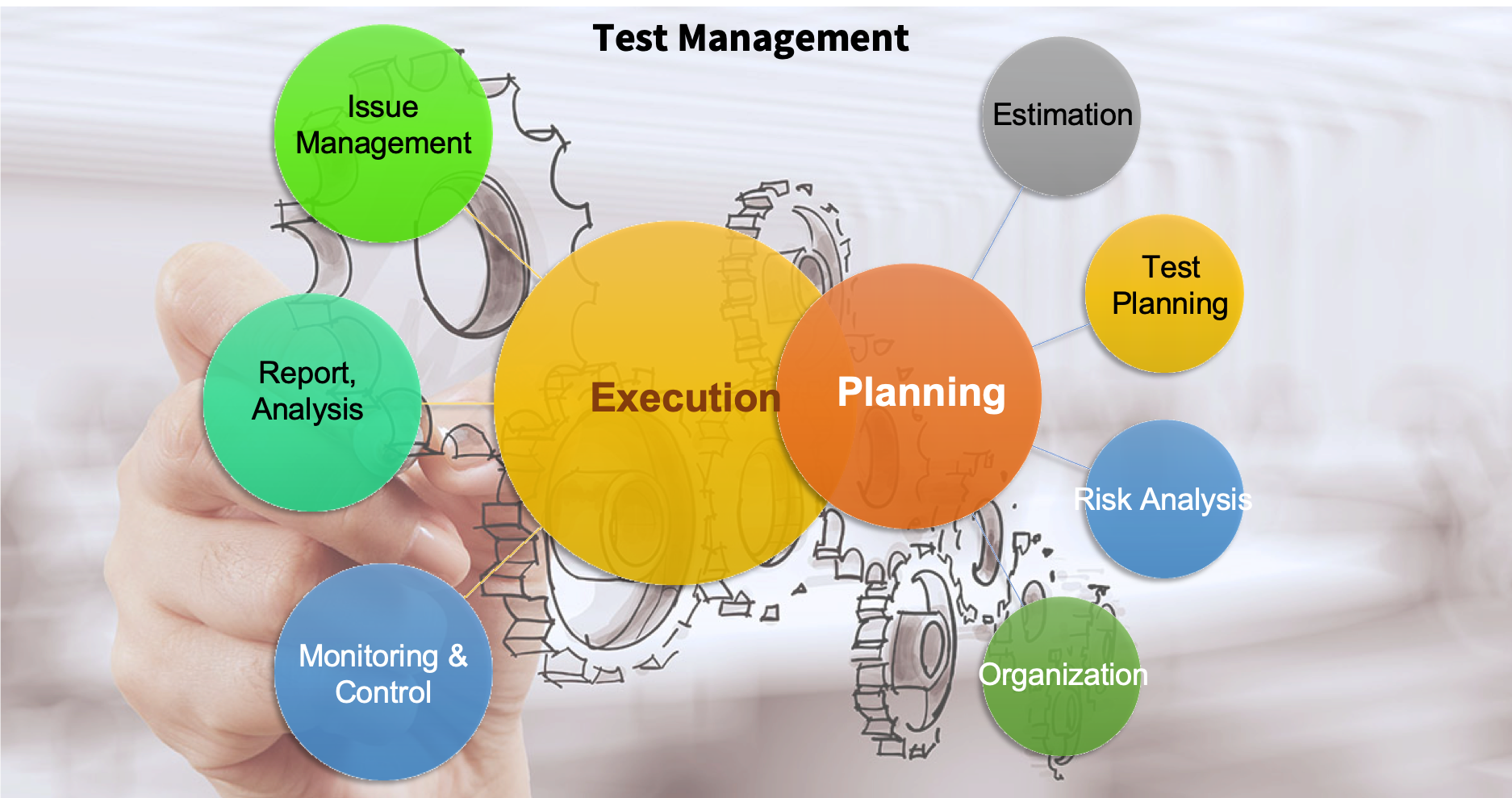
The effectiveness of the test management practice can be validated by defining, measuring & tracking quality goals.
Test management is a practice of organizing and controlling the process and artifacts that are required for software testing. As the technology & business process evolves Test Management has become more complicated & important as it not only involves planning, developing, executing, and assessing all testing activities but also involves tracking dependencies and relationships among test assets. The effectiveness of the test management practice are validated by defining, measuring and tracking quality goals.
Our Functional Testing approach includes:
Test Planning: The Test plan is comprehensively done, which includes functional testing, regression testing and compatibility testing process
Definition & Verification of Requirements: While switching from conceptual state to functional code, the requirements definition and verification process can be done effectively.
Functional Decomposition: Every functional area is independently tested against the given scope and
on completion of review of these test results the team proceed with performing integration testing.
Test Case: The test cases are mapped against each functionality covering all aspects of software functional requirements.
Traceability Matrix: Through developing traceability we ensure creating a cost effective and complete error-free quality solution and do not miss any functional points

By leveraging Magnum QA’s Platform compatibility testing services, reduce your cost and management overheads and speed up the software development lifecycle.
Adaptability: Through Platform Compatibility testing we ensure that an IT product automatically adapts to all available devices, operating systems & browsers.
Quality: Platform Compatibility testing will ensure the overall performance quality of an app across browsers & devices.
Bugs Identification: Through this testing our team identifies all kinds of bottlenecks affecting quality & performance of the software application on available platforms.
Release Cycle: It Is Mandatory to complete the platform compatibility testing process for ensuring Successful release of an app to the market. The testing is performed at every release cycle of the software application.
Enhanced User Experience: It is important to understand the user’s preference and ensures that the software is designed so that the users will be more satisfied if a specific IT product works perfectly well on their devices.

Our Performance Testing Services Includes below processes:
System Configuration Testing: this is the preliminary testing performed for all software product to validate the application working across multiple environments and configurations.
Load Testing: Validates the software by injecting enormous amount of data to observe the behaviour under expected Load. This testing is performed repeatedly until the desired results are achieved by fine tuning the performance of the software.
Data Volume Testing: The Software’s efficiency & productivity is checked by increasing the data volume of stored & processed data. This will also check the memory usage & data loss patterns.
Scalability Testing: A Complete Validation of Software Design & Architecture for upscaling capability based on load, technology & environment.
System Stability: Measuring the Robustness of the application by testing on various hardware environments and with different interfaces and user groups.

Our Testing experts make sure that responsive testing is satisfying all the below-mentioned quality of the software application
Enhance Quality: We confirm that Responsive testing enhances the overall performance quality of any website on all mediums.
Uniformity: ensuring validation of sharing relevant and same content on mobile, desktop and tablet devices with responsive testing.
Improved User Experience: Testing to provide better user experience through Navigation, Presentation in websites design which receives more online traffic.
Higher Ranking: It is critical to validate the main business advantage as Responsive websites always rank on higher positions in Google search results.
User Engagement: It is important to Keep the users engaged with improved User experience, which in turn will lower the user’s bounce rate.

We set clear expectations around the desired outcome for UAT. We ensure validating that the required business functions are operating in a manner suited to real-world circumstances and usage.
Functionality: Validating the Intended behaviour of the application as per the defined scope and design is the primary process of User Acceptance Testing ensuring a flawless movement of software application to production environment.
Realtime Data:Simulating the real time environment with relevant data which are used by end customers is key for User Acceptance Test process.
Efficiency: Our UAT test analysis measures will make an IT product more efficient by meeting the required development criteria.
Accuracy: As this is final stage of Quality testing process, our testing team ensures the accuracy of product results at the time of its release in the market.
Performance:UAT testing identify the changes required to improve overall performance when the application is simulated with multi-user access with continues flow of data from various sources.


The test planning phase is to define set of tasks for identifying what to test?, why to test?, when to test? and where to test?

Test Authoring is defined for documenting the specific steps that are required to perform a given test.

The Actual testing is performed during this phase. This involves running the tests by assembling sequences of test scripts into a suite of tests.

During the Test Execution the Test Logs and Bugs identified during the testing are captured and will be provided as Report outputs during this phase.
Through increasing adoption of DevOps and Agile in Testing practices, It implicates the importance of time management for testing. As the business expectation is pushing the process for short “test cycles”, it is difficult to balance between constantly changing priorities and shifting focus within tasks.
Hence, it is recommended to initiate the test management process as early as possible. Though it is difficult in identifying the right test resources at an early stage, the high priority test case identification can be done at early stages. Once the use cases are identified, it will help in deriving the test procedures. In the absence of use cases, the tests can be derived from the validation of initial requirements. Developing the tests early on helps in overcoming the challenges posed due to time constraints in test cycle.
Iterative testing practice, helps generation of testing artifacts and results early in the project lifecycle. It is important to organize the various test artifacts and resources for iterations for an effective test management practice. It is always challenging to ensure readiness of appropriate hardware resources & human resources available for testing. Getting the right resources at the right time for testing can be difficult. The process of resource buffering and sharing the resources can be of help at this stage to an extent, which later can be replaced with project specific resources.
An effective test management process involves creating test artifacts in such a way that they can be reused easily. Building and Re-usability of test artifacts across the projects improves testing team's efficiency and acts as a solution for the challenges faced by working under the pressure of limited time and limited resources. Not only those artifacts that are used in test automation can be reused but also test procedures and planning information can be reused.
It is recommended to have cloud-based test management tools that allows distributed usage of common platform across the globe for sharing information anytime, anywhere. It is essential to have a proper strategy for tool identification and usage which can leverage usage across various teams and geographical locations for performing effective test management. It is also important to ensure that the data is synchronized automatically across locations.
The test management process should be customizable and flexible in order to automate workflows. The process must be repeatable in order to render predictability. There should be room for making revisions and adjustments, especially in iterative projects. As different projects have different specific needs, defining and enforcing a flexible testing process will help to optimize testing to meet the changing needs.
A good test management tool helps to document test configurations. They help in planning and coordination of test execution across multiple builds and applications. There are many test automation tools which help to automate the test management process. These tools are time-saving and help in improving testing outcomes. The test management tools help to track the relationship of testing to requirements. They facilitate organizing test cases and reusing them. A test management tool allows calculating test coverage and generates various reports.


